
Business Transformation Consulting: What It Is and How to Use It
Business transformation consulting is outside help in changing how a company makes money, runs its operations and uses technology, so results improve in a lasting way and not just on a slide deck. For a small or mid-sized business, the useful version starts with how revenue is earned and where it leaks, then fixes processes, and only then brings in automation or AI where it clearly pays. The big-firm version is built for enterprise programs. This guide covers what a consultant does, how an engagement runs, what to measure and how to choose one.
RaremindImprove Operations Before Adding TechnologyRaremind’s Money Map identifies lost revenue, excessive costs, and process inefficiencies, with independent advice focused on your business.Explore Raremind’s approach
TL;DR
A business transformation consultant diagnoses where a company loses revenue, wastes cost or runs slow processes, then helps fix them and make the fixes stick.
Good engagements follow one order: define the problem, measure a baseline, find root causes, fix the process, then automate what is left.
Improve a process before you automate it. Automating a broken process only makes the dysfunction faster.
Judge a consultant by independence, a clear method and measurable outcomes, not by the size of the tool stack they recommend.
Smaller companies usually get more from an ongoing advisory relationship than from a one-off report.
Table of Contents
What business transformation consulting covers
Business transformation vs. digital transformation
How large firms and smaller advisors differ
How an engagement typically works
Fix the process before you automate it
When you actually need a consultant
What to look for in a transformation consultant
Costs, timelines and risks
Measuring whether it worked
Our perspective
How Raremind works with you
Sources
What business transformation consulting covers
“Transformation” is a loose word, so it helps to pin it down. In practice, a transformation consultant (some firms say “advisory”) helps leadership make and carry out significant changes to how the business works. Academic research describes the wider field of strategy and management consulting as advice on corporate strategy, organizational restructuring, operational improvement, process optimization, performance management, procurement, supply chain and project management. Transformation work sits across several of those at once.
For a company with 10 to 200 people, the real problems tend to be more specific than the label suggests:
Revenue leaks. Leads that never get followed up, quotes that go out late, renewals nobody owns, invoices that sit unsent.
Excess cost. Overlapping software subscriptions, manual rework, duplicate data entry, vendors nobody has reviewed in years.
Slow or inconsistent processes. Work that depends on one person’s memory, handoffs that stall, approvals that add days.
Unclear technology direction. A pile of tools bought one at a time, and questions about whether AI is worth the effort.
If you recognize two or three of these, you are probably looking at an operations and revenue problem that technology may or may not solve. A good consultant finds out which before recommending anything.
Business transformation vs. digital transformation
The two terms get mixed up. Digital transformation starts from technology: which platform, which integration, which model. Business transformation starts from the business: where money comes from, where it is lost, and what has to change to improve that.
The distinction matters because the order decides the outcome. A Cambridge and MIT-affiliated report based on interviews with 14 companies in the U.S. and Europe found that digital transformation works best when it is integrated with business strategy, and it recommends measuring inputs, throughputs and outputs so you can see whether the effort pays off. In other words, strategy first, tools second.
How large firms and smaller advisors differ
The firms that dominate search results for this topic build multi-year programs for large enterprises, with big teams and big budgets. That model rarely fits a business with a few dozen employees and an owner who still approves purchases. Smaller companies usually need three things from an advisor:
A quick, honest read of where the money is going.
A short list of changes ranked by payoff, not a 90-page report.
Someone who stays involved while the changes are put in place.
That is why the form of the engagement matters as much as the consultant’s résumé. A retainer or a tightly scoped project often fits better than a long, open-ended program.
How an engagement typically works
The details vary, but credible engagements follow a similar arc. The 2024 Organizational Effectiveness Handbook from the American Public Human Services Association, a professional body, lays out a sequence of defining priority improvements, assessing strengths and gaps, identifying root causes, planning quick-, medium- and long-term improvements, implementing action plans and monitoring impact. Translated to a business setting, it looks like this.
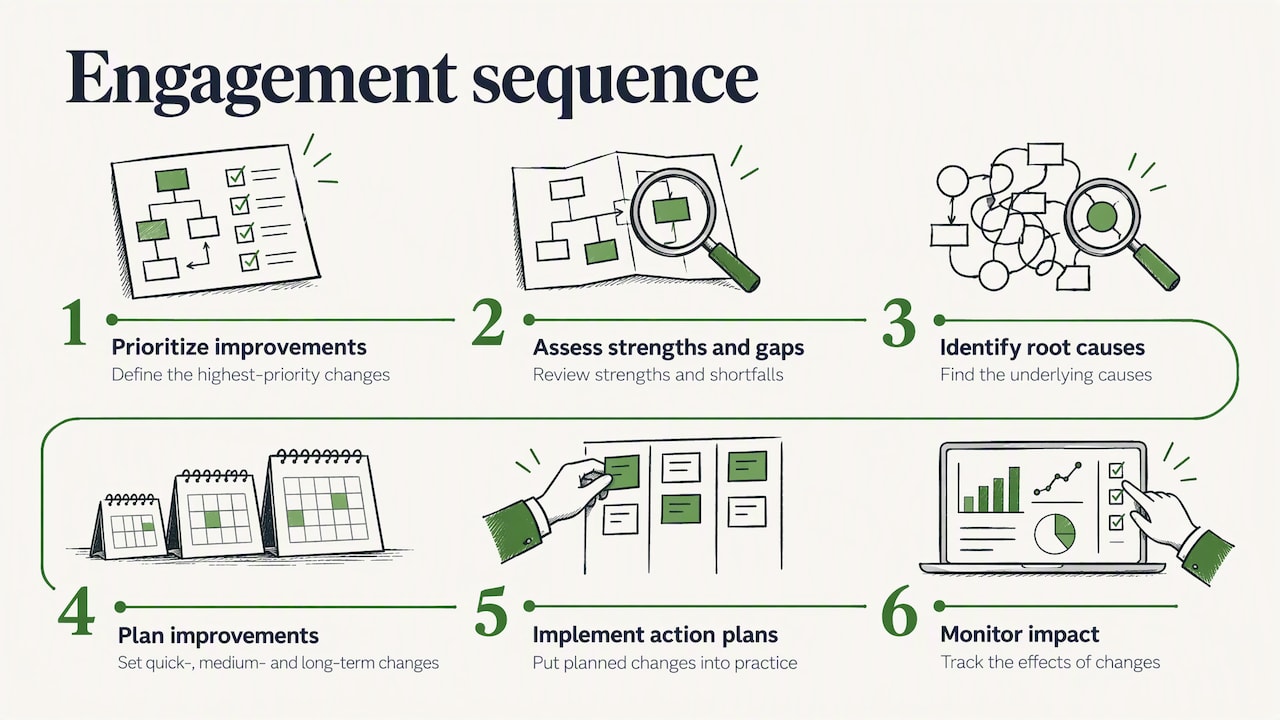
Step 1: Define the problem in operating terms
“We want to grow” is a goal, not a problem. “Quotes take six days to send and 30% never get a reply” is a problem. The first job is to turn vague pain into something you can measure.
Step 2: Map how work and money actually flow
This is the diagnostic core. ASQ’s DMAIC guidance recommends documenting the true process, identifying steps, inputs and outputs, and establishing baseline performance with trustworthy data. “True” matters: the process people describe in a meeting and the one they follow on a Tuesday afternoon are often different.
Two of our guides go deeper on this stage: capability mapping shows how to lay out what your business does and who owns it, and operating model design covers how those pieces fit together.
Step 3: Find the waste and rank it
The University of California, Berkeley’s business process management office classifies work as customer-value-added, business-value-added or non-value-added. It names waiting, rework, redundant approvals and unnecessary handoffs as non-value-added work to target first, and suggests prioritizing the waste with the highest customer impact. That ranking step is what keeps a transformation from becoming a list of 60 equally urgent tasks.
Step 4: Fix the process, then decide on tools
Standardize the work, remove steps and clarify ownership. Only after that do you ask what software or automation would help. Our guide to process standardization walks through how small businesses do this without adding bureaucracy.
Step 5: Implement and measure
Changes are rolled out in stages, with owners and metrics attached. This is where many engagements fail, because the report is delivered and nobody carries it forward. Ask any consultant who is responsible for implementation, and for how long.
Step 6: Sustain the gains
ASQ’s change-management guidance says redesigned processes endure when leaders sponsor the change, affected employees understand it and are trained, progress is monitored against metrics and new practices are embedded in management systems. Improvements that nobody reviews tend to drift back to the old way.
Fix the process before you automate it
This is the single most useful rule in transformation work. AICPA & CIMA’s 2026 process-optimization guide warns organizations to improve processes before implementing automation or AI instead of automating broken ones.
A practical example: a company wants an AI assistant to answer customer messages. If the underlying questions come from confusing invoices or unclear delivery windows, the assistant will answer the same avoidable questions faster. Fix the invoice and the delivery promise, and the volume drops before any tool is bought. Once the process is clean, it is much easier to judge which AI customer service tools suit a small business and which would sit unused.
The same logic applies to any digital project. A website rebuild, for instance, goes better when you audit what already works before redesigning, so you do not discard assets that bring in customers.
If you are unsure whether your business is ready, our AI readiness assessment guide maps revenue workflows before any tool is chosen. And if your software costs keep climbing, application rationalization helps you see which subscriptions overlap, and data integration strategy covers how the ones you keep should share information.

When you actually need a consultant
Not every inefficiency needs outside help. A useful test is whether the problem is urgent, valuable and beyond what your team can handle alongside daily work. A 2025 executive roadmap from ConsultingQuest says external consulting is often justified for high-value, urgent initiatives, and recommends weighing cost and benefit against your other priorities.
Signs it is time to bring someone in:
Revenue is flat or falling and nobody can say exactly where it is being lost.
Staff spend large parts of the week on manual re-entry, chasing approvals or reconciling spreadsheets.
You have bought several tools and still rely on workarounds.
You are considering AI or automation but cannot say which process it would improve.
The business depends on a few people who hold the process in their heads.
Signs you can probably handle it yourself: one clearly defined process is broken, you know the cause, and someone on the team has time to own the fix. For cost-focused problems, our list of cost reduction strategies for small businesses is a good starting point.
What to look for in a transformation consultant
Credentials and brand names matter less than how the consultant works. Use these criteria.
Criterion | What good looks like | Red flag |
|---|---|---|
Starting point | Begins with how your business earns money and where it leaks | Begins with a platform or vendor recommendation |
Independence | No software resales and no vendor commissions | Paid by the tools they recommend |
Method | A repeatable approach, tailored to your situation | Generic slide deck, or no method at all |
Deliverables | Ranked, costed actions with owners | A long report with no implementation path |
Measurement | Baseline set first, results reviewed against it | Success defined after the fact |
Involvement | Stays on through rollout | Hands off after the presentation |
The independence question deserves extra attention. A consultant who earns a commission on software has an incentive to find a software answer. Ask directly how they are paid, and whether any recommendation could earn them money beyond their fee.
Costs, timelines and risks
Prices vary widely by firm and scope, and published U.S. benchmarks for small-business engagements are scarce, so treat any quote as a negotiation between scope and budget. ConsultingQuest’s roadmap advises you to define the problem, the desired outcome and how success will be measured before comparing consulting cost with internal capacity.
One data point on timing: a Belgian administrative-data study from the National Bureau of Economic Research found that engagements typically lasted less than one year. It is a European sample and not a U.S. price guide, but it matches what most owners find: a focused engagement runs in months, not years.
The main risks are predictable:
Scope creep. Fix by agreeing on the problem and the metric before starting.
No owner inside the company. Name one person who is accountable for each change.
Tool-first thinking. Buying software before the process is clear.
No baseline. Without one you cannot prove the change worked.
Measuring whether it worked
Pick a small set of measures tied to money and time: days to send a quote, close rate, invoice-to-cash days, hours of manual work per week, number of paid tools. Record them before any change, then review monthly.
The Cambridge-MIT report mentioned above suggests measuring inputs, throughputs and outputs: what you put in, how work moves, and what results come out. For the longer view, the CAM-I Performance Management Framework describes eight continuous steps from readiness assessment through measuring performance improvement, which treats transformation as a repeatable cycle and not a one-time project.
There is evidence that the effort can pay. MIT CISR’s 2018 analysis of 216 companies found that those at least 50% through digital transformation had 32% higher net margins and 67% higher revenue growth than those less far along, relative to industry averages. That is a correlation among large companies, not a promise for your business, but it shows why steady, measured progress is worth the discipline.
Our perspective
Most owners who come to us have already been pitched a tool. A CRM, an AI assistant, a new platform. What they have not had is a plain answer to a simpler question: where does our money actually go, and where does it leak?
That is why we start with the Money Map. It lays out how your business makes money, step by step, and shows lost revenue, excess cost and process friction in one place. The method is the same for every client. The recommendations are not, because every business leaks in different places.
We do not sell software and we take no vendor commissions. That is deliberate. When we say a tool is not needed, or that two of your subscriptions should become one, nothing in it benefits us. The goal is not to turn you into a tech company. It is to make the business you already run more profitable, using automation and AI only where they earn their place.
We also think transformation should not end with a report. Improvements need someone to keep the work moving after the diagnosis, which is why we work as an ongoing advisor for most clients.
Mirko
How Raremind works with you
Our plan, Your Digital & AI Office, is an ongoing advisory relationship for a flat €995 per month. It covers mapping your current workflows with the Money Map, finding revenue leaks and excess cost, advising on automation and AI strategy, reviewing your vendors and tools, and continuing strategic support as changes roll out. For larger, hands-on initiatives we scope fixed-fee projects separately.

If you want an independent read on where your business loses money, see how Your Digital & AI Office works.
FAQ
What does a business transformation consultant do?
A transformation consultant diagnoses how your business operates, identifies where revenue, cost or process problems sit, recommends changes in priority order and helps put them in place. The field draws on strategy and operations topics such as process optimization, performance management and procurement. The best ones also help you measure results afterward.
Is business transformation the same as business transformation advisory?
In everyday use the terms overlap. “Consulting” often implies a defined project, while “advisory” suggests ongoing guidance and decision support. What matters is what is actually delivered: a diagnosis, a ranked plan, help with rollout and a way to measure outcomes.
How long does a transformation engagement take?
It depends on scope. A diagnostic and first round of fixes can take weeks to a few months, while larger initiatives run longer. One European study found that consulting engagements typically lasted under a year, though that is not a U.S. benchmark.
Do we need new software to transform the business?
Not necessarily. Professional guidance recommends that organizations improve their processes before automating them. Often the first gains come from removing steps, clarifying ownership or consolidating tools you already pay for.
How do I know if the consultant is independent?
Ask how they are paid. If they resell software or earn commissions from vendors, their advice may lean toward those products. An independent advisor is paid only by you, and can say plainly when a tool is not the answer.
Sources
Cambridge and MIT, Realizing the Full Potential of Digital Transformation, 2020
ConsultingQuest, Consulting for Business Transformation roadmap
MIT CISR, Becoming Future Ready Requires Organizational Explosions, 2018