
Process Standardization: A Practical Guide for Small Businesses
Process standardization means agreeing on one consistent, repeatable way to run a process, then making sure people actually run it that way. Writing a document is the easy part. The hard part is training, following, and measuring, and that is where most small and mid-sized businesses stall. This guide shows what to standardize first, how to do it without freezing your team, and how to tell whether it worked.
RaremindMake Better Processes Work HarderRaremind maps how your business generates revenue to find process inefficiencies and improve operations without pushing unnecessary technology.Explore Raremind’s approach
TL;DR
Standardize the processes that touch revenue and cost first. Leave genuinely local or creative work flexible.
An SOP on a shared drive is not a standard. A process is standardized only when it is documented, trained, executed, and measured.
Run a fit-gap review before you write anything. Research on one large program found only about 36% of activities fit a master model without change.
Standardize before you automate. Automating an inconsistent process just makes the inconsistency faster.
Treat standards as living documents, refined with feedback from the people who do the work.
Table of Contents
What process standardization actually is
Why standardize: the benefits that show up on the P&L
Paper standards versus executed standards
How to standardize a process: a six-step method
Make it a people project, not a documentation project
Standardize first, then automate
Perspective: what we see when we look at how a business makes money
Common mistakes to avoid
How to know it is working
Where we can help
Sources
What process standardization actually is
Standardization is the discipline of choosing one best-known way to perform a process across every person, shift, team, and site. Practitioner guides describe it as replacing the dozens of slightly different ways people do the same task with a single repeatable one. Academic reviewers define it in similar terms: a practice aimed at consistency across organizational processes, in support of service quality and cost control.
You will see related words used loosely. Standardizing processes, process harmonization, and process conformance overlap, but they are not identical:
Term | What it means in practice |
|---|---|
Standardization | One defined way to run a process, used everywhere it applies |
Harmonization | Aligning similar processes across units while allowing agreed variations |
Conformance | Measuring how closely real execution matches the defined standard |
Documentation standards | Rules for how procedures are written, formatted, versioned, and approved |
For a company of 10 to 200 people, the practical goal is simpler than any of these terms suggest. You want the same lead to get the same quote, the same order to get the same handling, and the same invoice to go out on the same schedule, no matter who is working that day.
Why standardize: the benefits that show up on the P&L
The benefits are real, but they depend on execution, not paperwork. Two small-company studies are worth knowing.
A 2025 study of Peruvian metalworking SMEs combined standard operating procedures with lean tools. Overall equipment effectiveness rose from 24% to 67%, and 5S audit scores rose from 34.4% to 84.3%. Changeover time also fell by 64.8 minutes. A 2023 case study of a small manufacturer found that standardized labor tools cut one cycle from 708 to 539 seconds, a reduction of roughly 24%.
These are manufacturing examples, and your numbers will differ. But the pattern carries over to service and professional businesses. When a process runs one way, you can see where time and money leak. When it runs ten ways, you cannot tell which version is costing you.
The typical gains for an owner-led business:
Fewer errors and rework. Steps stop depending on someone’s memory.
Faster onboarding. New hires learn one method instead of three.
Cleaner data. Consistent inputs make reports and dashboards believable.
A reliable baseline for improvement. You cannot tell whether a change helped if the process was different every time.
Easier automation. Software works on rules, and rules require a standard.
Paper standards versus executed standards
The most common failure is confusing documentation with execution. One manufacturing resource lays out four levels of standardization: documented, trained, executed, and enforced or measured. By its account, most companies stop at level two.
Here is how to check where a process of yours really sits:
Documented. Is there a written procedure that matches how the work is supposed to go?
Trained. Can each person who runs the process explain it without opening the document?
Executed. If you watched three people do it this week, would you see the same steps?
Measured. Do you find out about deviations from data, or only when a customer complains?
Pick one process, say quote-to-cash, and answer honestly. Most owners find the document exists, the training was a one-time walkthrough, and execution varies by person. That gap between level one and level three is where the money is.
How to standardize a process: a six-step method
1. Start with money, not with the process list
Do not begin by cataloguing every workflow. Begin with how the business makes money and where it loses it: leads that go cold, quotes that go out late, jobs that get redone, invoices that sit unsent. Rank processes by how much revenue or cost they touch. Two or three will matter far more than the rest.
2. Map what actually happens
Sit with the people who do the work and map the process as it runs today, not as the handbook says it runs. Note every handoff, every spreadsheet, every informal workaround. A shared whiteboard or a plain document is enough. You are looking for variation: where do two people do the same job differently?
3. Run a fit-gap review
Compare your current practice against the target way of working. A fit-gap study found that only about 36% of activities fit a master model unchanged. Of the rest, nearly 29% needed process placement shifts, 20% required IT infrastructure updates, and 16% required fundamental changes in working methods. That was a large corporate program, so treat the numbers as an illustration, not a forecast. The lesson is that most of a standardization effort is change management, not writing.
4. Decide what is core and what stays flexible
Uniformity is not free. Research on global process models notes a tension between enterprise-wide standardization and local responsiveness. The workable answer is to define which processes are core and must be identical, and which allow local adaptation under clear rules.
A simple test: if a variation changes cost, risk, customer experience, or data quality, standardize it. If it only changes style, leave it alone.
5. Write it short, then train on it
A good standard fits on one or two pages: purpose, owner, trigger, steps, inputs and outputs, and what done looks like. Use screenshots and checklists over prose. Then train people on the real work, with the real tools, and have them run it once while you watch.
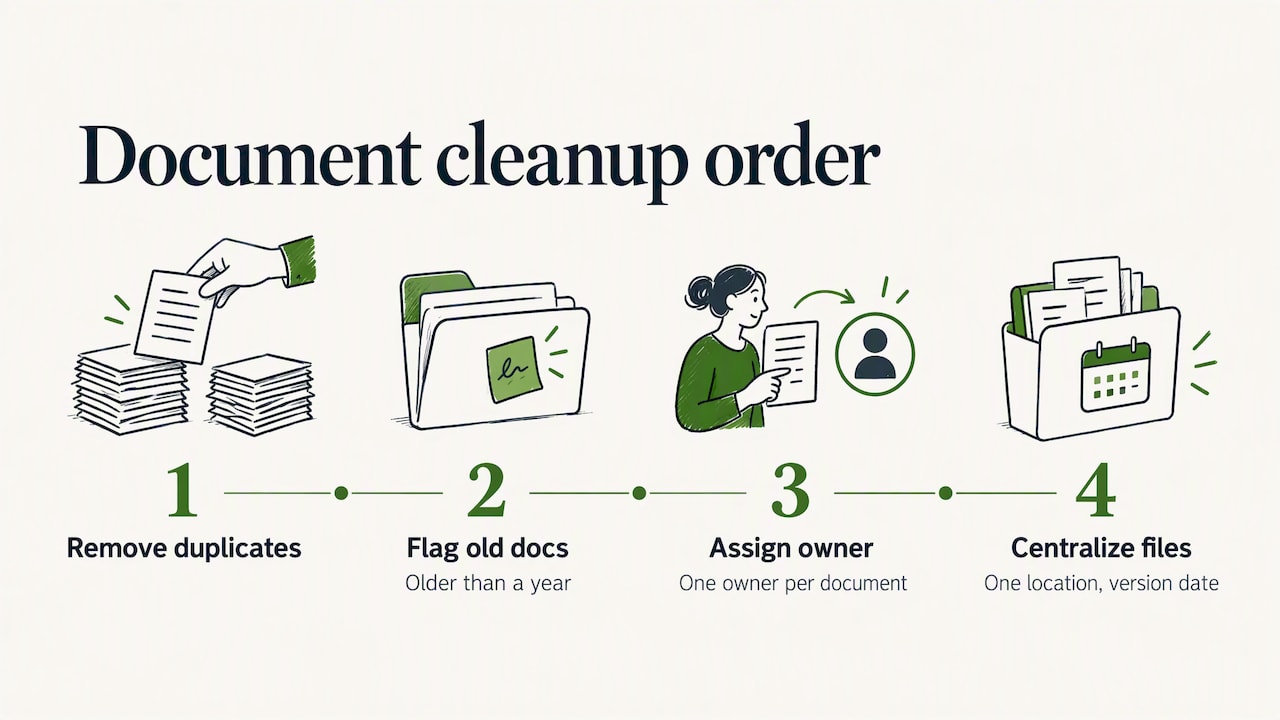
If your process documentation is a mess, clean it up in this order: delete duplicates, mark anything older than a year for review, assign one owner per document, and put everything in one location with a version date. That is most of what people mean by a document control process in a small company. Formal regimes such as ISO 9001 add requirements for approval and retention, but a small business gets most of the value from one location, one owner, and one current version.
6. Measure conformance and review on a schedule
Choose one or two indicators per process: cycle time, error rate, percent of jobs following the standard. Review them monthly. A simple spreadsheet or a compliance dashboard is enough to start, as long as someone owns it. Add software later, once the numbers are worth tracking automatically.
Make it a people project, not a documentation project
Standards fail when they are handed down. Practitioners stress that standardization is more about people and culture than documents. The best results come when leaders and operators talk openly and the standard is revised from what happens on the floor. The same source recommends leadership walkarounds, where managers watch and coach real execution instead of relying on static SOPs that go stale once printed.
In practice:
Let the people who do the work draft the first version.
Hold a short monthly review where anyone can propose a change.
Version every change and tell people what changed and why.
Ask frontline staff what makes the standard hard to follow before you blame discipline.
Handoffs between teams are where standards most often break. The marketing-to-sales handoff is a good example: a five-step handoff with a service-level agreement and shared documentation gives both teams a defined moment of responsibility, so leads stop falling between them. The same idea applies to any handoff, from sales to delivery or delivery to billing.
Standardize first, then automate
Operational experts often make the point that standardization is a prerequisite for sustainable improvement. Improve an unstandardized process and the changes land inconsistently or on the wrong variables. The same logic applies to software. If three people handle refunds three ways, a tool will not decide which is right. It will encode whichever you configured first.
That order also protects your budget. Many businesses buy tools to fix problems that a clearer process would have solved. For more on that thinking, see our guide to cost reduction strategies that put operations first, and our take on when AI belongs in your strategy and when it does not.
Perspective: what we see when we look at how a business makes money
We start every engagement by asking how the business earns revenue, then looking for where that revenue leaks. We do this with a tool we call the Money Map. It lays out current workflows against revenue, cost, and effort, so the gaps show up before anyone talks about software.

What we keep finding is that standardization problems are rarely about missing documents. The document exists. The trouble is that three people run the process three ways, nobody measures it, and the owner assumes it works because nothing has visibly broken. The fix is usually smaller than people fear: pick the two or three processes closest to revenue, agree on one way, train on it, and look at the numbers each month.
We also do not sell software and take no vendor commissions. That matters here, because a standardization effort is exactly the moment when a vendor will tell you the answer is their platform. Sometimes a tool does help. Often a checklist, a clearer handoff, and a weekly review do more, and cost nothing. Our advice follows what the process needs, not what anyone is selling.
— Mirko
Common mistakes to avoid
Standardizing everything at once. Start with the few processes that carry the most revenue or cost.
Writing for auditors, not users. If a new hire cannot follow it on day one, rewrite it.
No owner. Every standard needs one named person who keeps it current.
Treating it as a one-time project. Standards are a living practice, refined as work changes.
Forcing uniformity where context differs. Define core versus flexible up front.
Skipping measurement. Without conformance data, you are back to level two.
How to know it is working
After 60 to 90 days on a single process, you should be able to answer yes to most of these:
Two different people produce the same output from the same inputs.
A new team member reaches full speed faster than before.
Errors, rework, or customer complaints on that process have dropped, and you can show the numbers.
The standard has been revised at least once based on feedback.
You can say, from data, what percent of cases follow the standard.
If you cannot answer, you are likely at level two. Go back to training and measurement before you add more documents.
Where we can help
If you would rather have an independent second set of eyes than do this alone, our Your Digital & AI Office plan is a flat monthly retainer at €995 per month. It covers mapping your workflows with the Money Map, finding revenue leaks and excess cost, advising on automation, and reviewing the tools you already pay for. Larger, hands-on initiatives are scoped separately as fixed-fee projects. If you are weighing this against a traditional engagement, read what founders actually need from strategic advisory.
FAQ
What is the difference between process standardization and process documentation?
Documentation records a procedure. Standardization makes sure everyone follows it. A documented process is only level one of four, and it still needs training, consistent execution, and measurement before it counts as standardized.
Which processes should a small business standardize first?
Start with the processes closest to revenue and cost: lead follow-up, quoting, order fulfillment, invoicing, and collections. These are repeated often and errors show up in cash flow quickly. Leave creative or highly situational work flexible for now.
Does standardization make a business rigid?
It can if you apply it everywhere. Define which processes are core and must be identical, and which allow local adaptation under clear rules. Treat each standard as a living document that people can propose changes to.
How long does it take?
A single process can usually be mapped, written, and trained in a few weeks, depending on its complexity and your team’s availability. The slower part is measurement and refinement over the following months. Expect to review each standard on a regular schedule rather than finish it once.
Do I need software to monitor compliance?
Not at the start. A spreadsheet with one or two indicators per process, reviewed monthly, is enough to show whether people follow the standard. Consider a dashboard or automation once the process is stable and the numbers are worth tracking automatically.
Sources
Fit-Gap Analysis as Introduction Step to Business Process Standardization
Operational Model to Improve On-Time Delivery: A Peruvian Case Study in Metalworking SMEs
Improvement Proposal To Increase Productivity Of A SME Using Standardized Labor and TPM Tools
Strategic Alignment: Evaluating Organizational Processes through the Lens of Global Standardization
Conceptualizing Business Process Standardization: A Review and Synthesis